Archive for the ‘I believe because it is absurd’ Category

We need more Walt Whitman’s

~ Sunday, March 14th, 2010

This makes so much sense!

From Andrew Sullivan comes this

From his article on the subject:

It’s difficult to take oneself with sufficient seriousness to begin any sentence with the words “Thou shalt not.” But who cannot summon the confidence to say: Do not condemn people on the basis of their ethnicity or color. Do not ever use people as private property. Despise those who use violence or the threat of it in sexual relations. Hide your face and weep if you dare to harm a child. Do not condemn people for their inborn nature—why would God create so many homosexuals only in order to torture and destroy them?

Be aware that you too are an animal and dependent on the web of nature, and think and act accordingly. Do not imagine that you can escape judgment if you rob people with a false prospectus rather than with a knife. Turn off that fucking cell phone—you have no idea how unimportant your call is to us. Denounce all jihadists and crusaders for what they are: psychopathic criminals with ugly delusions. Be willing to renounce any god or any religion if any holy commandments should contradict any of the above. In short: Do not swallow your moral code in tablet form.

  • Share/Bookmark

[Lenten] Practice

~ Wednesday, February 17th, 2010

Internet Addict

My daughter is using reduced time on the internet as a Lenten practice. While I don’t really participate in the season of Lent, it seems like a good idea anyway. As my son said on FB, “Lent is like a New Year’s Resolution do over. So one starts out the year with a resolution to eat healthier, but then is eating Krispy Kreme’s by the end of January. But then Lent rolls around and eating healthier for 6 weeks sounds so much more doable than for a full year. And hey, you get to binge on peeps at the end of it.”

So, I’m going to try it. As I responded on my daughter’s FB entry, “Yeah, think I will join you. I’m going to do it in honor of my father too. He used to read the Dallas Morning News in the morning and watch Walter Cronkite at suppertime and he was pretty well informed. So, for me, once in the morning, once in the evening after work and that’s it! Can I do it? Yes. I. Can.”

  • Share/Bookmark

The No-Name Decade

~ Monday, December 28th, 2009

Past decade 2000-2009

WHAT DO YOU CALL IT? (Reflections on a hard-to-name decade), by Rebecca Mead, JANUARY 4, 2010

In retrospect, it might be recognized as a troubling harbinger that, ten years ago, no consensus could be reached in this country on what to call the decade upon which we were about to embark. The ohs? The double-ohs? The zeros? The zips? The nadas? The naughties? As the reassuringly comprehensible nineties were drawing to a close, all these were suggested as possible designations for the coming era. When Madison Avenue and the collective editorial boards of the nation’s newspapers failed to come up with a killer appellation in advance, there was at least confidence that, by decade’s end, a majority-pleasing solution to the problem of decennial nomenclature would have presented itself.

As we near the end, however, we still don’t have a good collective name for the first decade of the twenty-first century—at least, not one beyond “the first decade of the twenty-first century,” which is gratifyingly lacking in cuteness but may be too wordy for practicality, particularly given contemporary constraints. (Call it that on Twitter, and you’ve used up a third of your character allotment.) Arguably, a grudging agreement has been reached on calling the decade “the aughts,” but that unfortunate term is rooted in a linguistic error. The use of “aught” to mean “nothing,” “zero,” or “cipher” is a nineteenth-century corruption of the word “naught,” which actually does mean nothing, and which, as in the phrase “all for naught,” is still in current usage. Meanwhile, the adoption of “the aughts” as the decade’s name only accelerates the almost complete obsolescence of the actual English word “aught,” a concise and poetic near-synonym for “anything” that has for centuries well served writers, including Shakespeare (“I never gave you aught,” Hamlet says to Ophelia, in an especially ungenerous moment, before she goes off and drowns) and Milton (“To do aught good never will be our task / But ever to do ill our sole delight,” Satan declares near the beginning of “Paradise Lost,” before slinking up to tempt Eve). To call the decade “the aughts” is a compromise that pleases no one, and that has more than a whiff of resigned settling about it.

But perhaps that’s appropriate, since this turned out to be the decade in which there were no good answers. It began in overwrought hysteria: recall that, this time ten years ago, the fear was abroad that civilization would come to a standstill, if not an end, when the world’s computers failed to recognize a date that didn’t begin with the digits 1 and 9. Having readied ourselves for that disaster, the one that actually did materialize, a year and a half later—the terrorist attacks of September, 2001—came as a surprise, even, apparently, to those who had been privy to intelligence memos warning of impending harm from militant-Islamist quarters. It has been suggested that the appropriate designation for this decade might be “the post-9/11 era”—an unswingy if otherwise apposite sobriquet. Others argue that to name the decade thus would be letting the terrorists win—as if the cumulative casualties of war and the infringements of civil liberties that took place under President Bush were not already evidence of at least partial victory on that score.

The events of and reaction to September 11th seem to be the decade’s defining catastrophe, although it could be argued that it was in the voting booths of Florida, with their flawed and faulty machines, that the crucial historical turn took place. (In the alternate decade of fantasy, President Gore, forever slim and with hairline intact, not only reads those intelligence memos in the summer of 2001 but acts upon them; he also ratifies the Kyoto Protocol and invents something even better than the Internet.) And if September 11th marked the beginning of this unnameable decade, its end was signalled by President Obama’s Nobel acceptance speech, in which he spoke of what he called the “difficult questions about the relationship between war and peace, and our effort to replace one with the other,” and painstakingly outlined the absence of any good answers to the questions in question.

In between those two poles, the decade saw the unimaginable unfolding: the depravities of Abu Ghraib, and, even more shocking, their apparent lack of impact on voters in the 2004 Presidential election; the horrors of Hurricane Katrina and the flight of twenty-five thousand of the country’s poorest people to the only slightly less hostile environs of the Superdome; the grotesque inflation and catastrophic popping of a housing bubble, exposing an economy built not even on sand but on fairy dust; the astonishing near-collapse of the world financial system, and the discovery that the assumed ironclad laws of the marketplace were only about as reliable as superstition. And, after all this, the still more remarkable: the election of a certified intellectual as President, not to mention an African-American one.

There was the ascent of the digital realm—with the happy surrender, on the part of hundreds of millions, to the congenial omniscience and possibly less congenial omnipotence of Google, and the perplexingly popular appeal of making available online all manner of information of the sort formerly considered private. Who would have dreamed, at the decade’s outset, not only that something like Facebook would exist but that, thanks to it, anyone would be able to view photographs of the company’s C.E.O., Mark Zuckerberg, in pajama bottoms and with red-eye uncorrected, lounging in an armchair and clutching a Teddy bear to his chest? Or that anyone would want to? And what of those other unlikely innovations and unforeseen blights of the era—small plates, Bump for the iPhone, Sarah Palin, Chinese drywall, jeggings?

Given all that has emerged in the past ten years, the failure to invent a satisfactory name for the period seems overdetermined—a reflection of our sense that the so-called aughts were not all they ought to have been, and were so much less than they promised to be. With its intractable conflicts and its irresolvable crises, its astonishing accomplishments and its devastating failures, the decade just gone by remains unnamed and unclaimed, an orphaned era that no one quite wants to own, or own up to—or, truth be told, to have aught else to do with at all.

  • Share/Bookmark

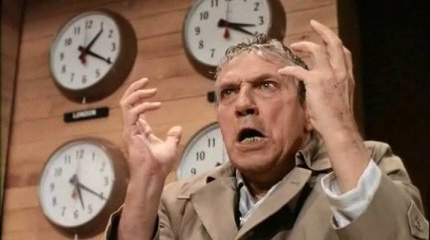
I’m Mad as Hell, and Don’t Call it “Populist Rage”

~ Wednesday, April 1st, 2009

Howard Beale in "Network"
The Ghost of Populism Walks Again, by Geoffrey Nunberg
“Fresh Air” Commentary, 3/30/09

Rage is all the rage right now, particularly the populist sort. Over the last month, I counted almost 200 news stories that paired populist with items like rage, fury, and frenzy, four times as many as in the whole of 2008. And there were more than 100 that mentioned AIG along with pitchfork, the implement that Stephen Colbert brandished as he urged his listeners to join him in forming an angry mob. The cover of the most recent Newsweek announced a feature section called “The Thinking Man’s Guide to Populist Rage” over a still from the 1931 film version of Frankenstein that shows the villagers in pursuit of the monster, with torches, cudgels, and dogs.

Tongue-in-cheek or not, those images suggest the specters that populism triggers for a lot of people: demagoguery, social disorder, mob rule, and a new age of class warfare. In a Wall Street Journal op-ed, Suzanne Garment warned Obama that you couldn’t just stir up a little bit of populism and turn it off when it gets inconvenient. Populism is dangerous, she said, recalling the racism that tainted some adherents of the original capital-P Populists, the radical movement that flourished in the western states and the South during the depression of the 1890’s. They advocated curtailing corporate power, an eight-hour day, and a graduated income tax — proposals frightening enough to lead their critics to describe them as “wild-eyed, rattle-brained fanatics.”

But that’s playing a little fast and loose with the P-word.

Go here to read the rest of this really great essay!

  • Share/Bookmark

The Big Takeover

~ Tuesday, March 24th, 2009
The global economic crisis isn't about money - it's about power

The global economic crisis isn't about money - it's about power

This is Pulitzer Prize material!

  • Share/Bookmark

“I understand that you want to make finance entertaining, but it’s not a f*&$ing game”

~ Friday, March 13th, 2009

Bad Business
Jon Stewart to Jim Cramer, March 12, 2009 –

“CNBC could be an incredibly powerful tool of illumination for people that believe there are 2 markets. One, that has been sold to us as long term. ‘Put your money in 401Ks, put your money in pensions, and just leave it there, don’t worry about it. It’s all doing fine.’

Then, there’s this other market, this real market that’s occurring in the back room where giant piles of money are going in and out and people are trading them and its transactional and it’s fast, but it’s dangerous. It’s ethically dubious, and it hurts that long term market so what it feels like to us, and I’m speaking purely as a layman, it feels like we are capitalizing your adventure by our pension and our hard earned money and it’s a game that you know…that you know is going on, but you go on television as a financial network and pretend it isn’t happening.”

  • Share/Bookmark

Quote of the Day

~ Tuesday, February 24th, 2009

The TV we’re not watching is nowhere as good as the books we’re not reading, the websites we’re not looking at, the 3 minute YouTube highlights of the TV we’re not watching, the games we’re not playing. We just don’t have a lot of time in our life for TV.

- Cory Doctorow-TWIT

  • Share/Bookmark

Old is In…Let’s Hope So

~ Thursday, February 12th, 2009

From the NYTimes comes this:

Op-Ed Columnist, Gail Collins, The Stump Theory

On Tuesday, a 10-year-old Sussex spaniel named Stump won Best in Show at the Westminster Kennel Club, becoming the oldest dog to win the title in the show’s 133-year history.

10 year old Stump (that's 70 in dog years)

Yet another sign of the emerging trend of 2009:

Old is in.

This is not exactly what we were expecting from the Age of Obama. When a 47-year-old becomes president by trouncing a 72-year-old opponent, there’s every reason to think that the tide is turning youthward.

For a minute or so, that seemed to be the case. The most high-profile cabinet job, Treasury secretary, went to Timothy Geithner, 47. Over at the bank bailout, a 35-year-old was in charge of the Office of Financial Stability. Hillary Clinton, 61, is headed to Bangalore and Beijing, leaving a 42-year-old replacement in her Senate seat. There was almost no one left in Washington who knew what Sputnik was, let alone the words to “The Ballad of Davy Crockett.”

Now, less than a month into the new administration, we’ve got generational backlash. Everybody who watched Geithner explain how he was going to rescue the banking system thought he sounded like a callow youth. Where’s gravitas when you need it? Time to bring on Paul Volcker (81).

Meanwhile, the great national heroes are US Airways pilot Sully Sullenberger (58) and flight attendants Donna Dent (51), Sheila Dail (57) and Doreen Welsh (58). Admit it, when you get on a plane these days, you feel worried if the crew members don’t look as though they’re receiving bulletins from the AARP.

The movie star du jour is Mickey Rourke, 56. Rourke has truly been preparing for this moment all his life, since thanks to some interesting lifestyle changes, he has looked 56 since around 1987.

Is this a baby-boomer plot? In 1972, The Times’s Russell Baker noted that the people he had always thought of as “the kids” did not seem to be reproducing. Baker decided that the Woodstock generation was conspiring to cut the birth rate so they would always be in the majority and could “go on being the kids for the rest of their lives.”

And what do you know? Mick Jagger is still touring.

My own personal theory is that we’re witnessing a defense mechanism triggered by the current economic unpleasantness.

Since it appears that nobody is ever going to be able to afford to retire, we’re moving into an era in which having your car fixed or your tonsils removed by a 75-year-old will need to seem normal. Meanwhile, young people are going to have to stay in school and keep their heads down since their elders have no intention of creating any job openings in the near future. So it’s better if we readjust our thinking and start regarding everybody as 20 years younger than the calendar suggests. Then you will feel much better when the 80-year-old postman delivers your mail and it includes a request for money from your 38-year-old offspring doing post-post-post-doctoral work at Ohio State.

At least this will be good news for anybody under the age of 40 who gets into a jam. If the Olympic swimmer Michael Phelps and the Yankee slugger Alex Rodriguez have drug issues, who cares? In the new adjusted way of viewing the country, Phelps is just a toddler and Rodriguez is barely in puberty.

And in their place, we have Stump. You may have missed his great star turn on Tuesday night. Strangely, the Westminster Kennel Club Dog Show does not get as much attention as, say, the Super Bowl, even though there are way more Americans who own dogs than play football. Perhaps if Bruce Springsteen (59) had done a half-time show at Westminster involving huge amounts of jumping around and a crotch-first slide into the camera, things would be different.

Stump, whose hobbies are sleeping and sleeping, is actually Champion Clussexx Three D Grinchy Glee, but nobody his age can remember all that. After a refreshing workout that involved a short walk around the driveway, he trotted onto the stage and wiped the floor with his younger competition, the most notable of which was a poodle that was conceived with the 25-year-old semen of a long-dead champion named Snapper.

Stump would be around 70 in human years, but Snapper — wow. Even given the fact that it was frozen, Snapper’s seed has to have been the equivalent of at least 150.

And so it goes. This week at the Grammy Awards, every other prize went to Alison Krauss, the 37-year-old bluegrass star, who had made the canny career choice of pairing up with the former Led Zeppelin singer Robert Plant, 60. “In the old days, we would have called this selling out,” Plant said as he scooped up his five awards.

Maybe not selling out is going to come back into fashion, too. But if there’s nobody left doing any buying, does it still count?

  • Share/Bookmark

E-mail Taglines

~ Tuesday, February 3rd, 2009

I just received an e-mail from a tech recruiter requesting my interest in a Senior Technical Writer position in Bellevue, WA…um, no.

But her e-mail tagline stopped me cold.

A large income is the best recipe for happiness I ever heard of.

Again, um, no.

  • Share/Bookmark